

Richmond Hill has always been one of the GTA's most liveable cities.
Great schools, a safe community, a vibrant mix of restaurants and culture along Yonge Street, and quick access to Highways 7 and 407. What it has lacked, until now, is a direct subway connection to Toronto.
That's about to change. The Yonge North Subway Extension is officially under construction, it's fully funded, and it's heading straight to Richmond Hill. For anyone considering a home in the area, this isn't background noise. It's a once-in-a-generation infrastructure shift, and buyers at Rosabella, InDesign Homes' community, are positioned right at the centre of it.
What Is the Yonge North Subway Extension?
The Yonge North Subway Extension (YNSE) is one of the largest transit infrastructure projects in Canadian history. Managed by Metrolinx and funded jointly by the federal government, the Province of Ontario, and York Region, the project will extend TTC Line 1 (Yonge-University) approximately eight kilometres north from its current terminus at Finch Station into Richmond Hill.
The extension will add five new stations along the route:
Steeles (underground)
Clark (underground)
Royal Orchard (underground)
Bridge (surface level, key intermodal hub)
High Tech (surface level)
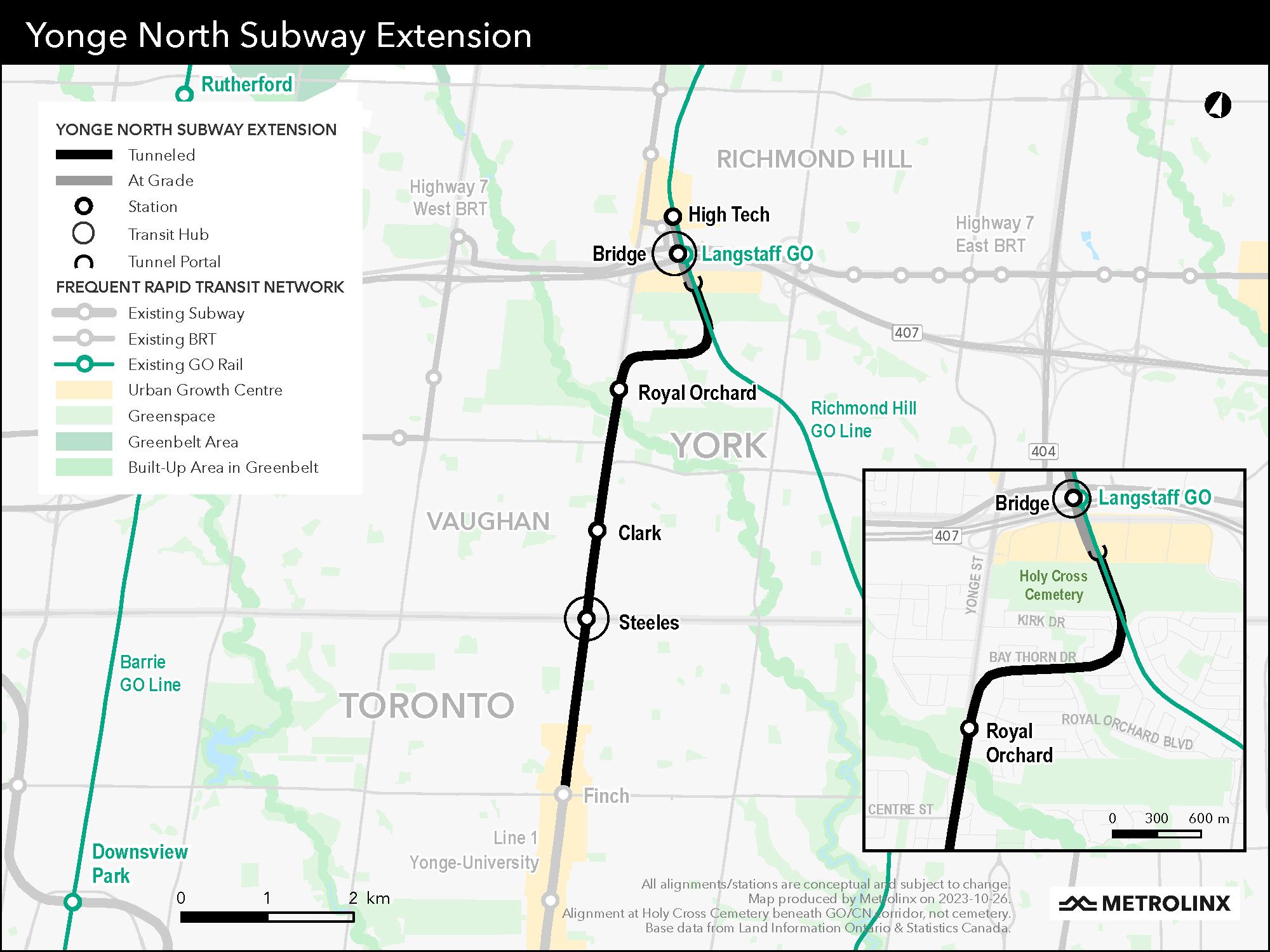
The tunnelled portion of the line stretches approximately 6.3 kilometres, running beneath Yonge Street before the line curves east, surfaces, and runs north along the existing GO rail corridor into Richmond Hill.
The Five Stations: What Each One Means
Steeles, Clark & Royal Orchard, The Underground Three
These three stations run beneath Yonge Street, extending Line 1 into York Region for the first time. They'll connect directly with TTC and York Region Transit bus routes, giving thousands of daily commuters in Thornhill and the northern Yonge corridor a direct ride into downtown Toronto.
Bridge Station, Richmond Hill's New Transit Hub
Bridge Station is the most significant of the five new stops, and the one most relevant to Richmond Hill buyers. Positioned between the Highway 7 and Highway 407 corridors, it will serve as the primary intermodal transit hub for the northern section of the extension.
What makes Bridge Station exceptional is its connectivity.
It will offer:
Direct subway access on Line 1 into Toronto
Connections to York Region Transit (YRT) and regional GO buses
A seamless transfer to the existing Langstaff GO Station, meaning riders can connect to GO train service across the province without a separate trip
High Tech Station
The final stop on the extension and the northern terminus, High Tech Station, further reinforces the Richmond Hill Centre area as the anchor of this new transit corridor. Like Bridge, it will connect with Langstaff GO and regional bus services.
Why This Matters for Richmond Hill Real Estate
Transit infrastructure doesn't just move people, it moves markets. The relationship between subway access and property values is one of the most well-documented patterns in Canadian real estate.
When the Spadina subway extension was extended to Vaughan in 2017, communities around the new VMC station saw dramatic increases in development interest, population growth, and property values. Richmond Hill is next, and the scale of this extension makes the Vaughan precedent look modest by comparison.
For buyers purchasing in Richmond Hill today, the calculus is straightforward: you're buying into a city that already has one of the best quality-of-life profiles in the GTA, at a point just before it gains the transit infrastructure that will reshape its accessibility entirely.
Where Rosabella Fits In
Rosabella sits at the corner of Yonge Street and 16th Avenue in Richmond Hill, on the very corridor that the YNSE will transform.
Yonge Street is the spine of this entire project. Every underground station runs beneath it. The extension follows it north. The new transit communities being built around the future stations are anchored to it. For a home at Rosabella, Yonge Street isn't just a convenient address; it's the connective thread between where you live and where the subway is going.
In the meantime, Rosabella residents already benefit from:
York Region Transit (YRT) and Viva bus routes along Yonge Street, connecting south to Finch Station and the existing TTC network
Langstaff GO Station for GO train service across the province
Highway 7 and 407 for drivers
Proximity to Hillcrest Mall, Longo's, Pusateri's, and the full retail and dining strip along Yonge
When the subway arrives, that accessibility becomes significantly more powerful.
Don't Overlook the HST Rebate
Buyers purchasing a Rosabella home right now have an additional financial advantage worth flagging: the new Ontario-federal HST rebate program is live, and homes from $1 million are eligible.
It's a one-year window. For buyers who move in 2026, the subway story and the tax savings story line up at the same time.
To understand the full rebate program in detail, read our complete guide: Everything You Need to Know About the First-Time Home Buyers' GST/HST Rebate.
Richmond Hill: The City That's Ready
Richmond Hill was already one of the GTA's strongest-performing cities before the subway was announced, consistently ranking among the safest communities in Canada, with exceptional schools, a multicultural population, and a thriving economy,
The Yonge North Subway Extension doesn't create that story. It amplifies it.
For buyers who have been watching Richmond Hill and waiting for the right moment, that moment is becoming harder and harder to defer.
Explore Rosabella or visit the Purchaser Portal to access all community documents and floor plans.
Sources: Metrolinx – Yonge North Subway Extension | City of Toronto | Infrastructure Ontario | York Region Rapid Transit Corporation | Housing, Infrastructure and Communities Canada


