
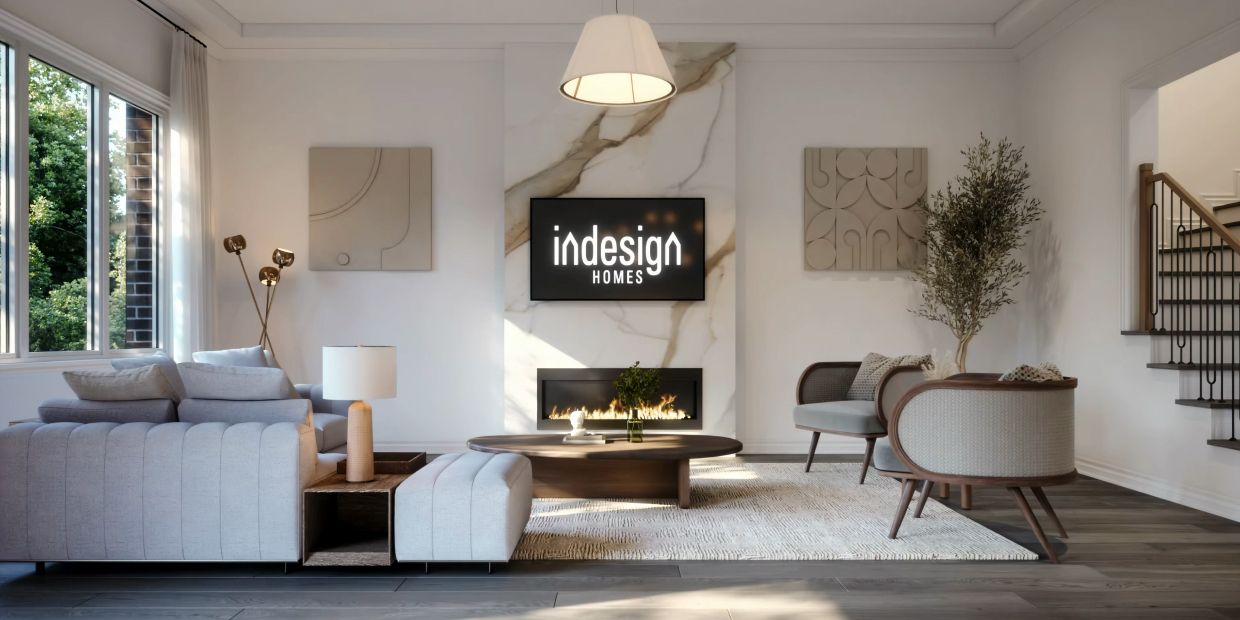
For most of the twentieth century, the answer was straightforward. Home was where you slept, ate, and spent weekends. It was a place you left in the morning and returned to at night. Its job was to be comfortable enough, large enough, and close enough to wherever life actually happened: the office, the school, the shops.
In 2026, home is no longer a supporting character in your life. It's the main event. And buyers across Canada are making decisions that reflect exactly that.
The Office Didn't Go Away. It Just Moved In.
Hybrid work is no longer a pandemic accommodation. For a significant portion of the Canadian workforce, it's simply how work works now. Two or three days at home per week isn't unusual; it's the norm. And that changes everything about what a home needs to do.
When your home is also your office two or three days a week, the guest bedroom that doubles as a storage room no longer cuts it. Buyers in 2026 consistently cite dedicated home office space as one of their top priorities, not a converted corner of the bedroom with a fold-out desk, but a real room with a door, natural light, and enough separation from the living areas to actually think.
The question buyers are now asking when they tour a home isn't just "where would the sofa go?" It's "where would I work?" And if the answer isn't obvious, the home loses points.
Bigger Isn't the Point. Better Is.
The early pandemic impulse was to chase square footage. More rooms. More space. More land. Get out of the city, get more of everything. That impulse made sense in the moment, but it's evolved into something more considered.
What buyers in 2026 want isn't necessarily more space; it's better space.
There's a meaningful difference. A 2,500 square foot home with a thoughtless layout feels smaller than a 1,800 square foot home where every room has a clear purpose, and the flow actually makes sense. Buyers have spent enough time inside their homes over the past five years to know what works and what doesn't, and they bring that knowledge to every showing.
Ceiling height has become a proxy for this quality. High ceilings, genuinely high, not a nominal extra inch or two, transform how a space feels. They create breathing room. They make natural light go further. They give a home a quality that's immediately felt but hard to articulate. This is why 10-foot ceilings on the main floor have moved from a premium upgrade to something buyers actively seek out and notice when they're absent.
The Kitchen Is No Longer Just a Kitchen
If there's one room that captures the shift in what home means in 2026, it's the kitchen. It was always important. Now it's the room the entire home is organized around.
The kitchen in 2026 handles breakfast, the school run debrief, the working lunch, the late-afternoon snack that happens because the office commute used to stop you, the dinner that doubles as family time, and the weekend entertaining that's migrated home from restaurants where it used to happen. It is the most used room in the house by a distance, and buyers know it.
Stone countertops have moved from aspirational to expected. Extended upper cabinetry that actually provides storage, rather than the token row of cabinets that populated builder-grade kitchens for decades. Under-mounted sinks. Pull-out faucets. An island or peninsula that can serve as a gathering point when guests arrive or a homework station when they don't.
The Bathroom Has Become a Sanctuary
This one is harder to explain rationally, but it's real and it's consistent: the bathroom, particularly the master ensuite, has become a significant priority for buyers in a way it simply wasn't a generation ago.
Part of it is the wellness shift. Canadians collectively spent years being told they couldn't go anywhere or do anything, and the response, once things opened up, was a genuine cultural reorientation toward self-care and personal ritual. The morning routine, the evening wind-down, these things matter to people now in a way that feels newly serious.
Spa-style bathrooms are appearing more frequently in listing descriptions precisely because the term resonates. Buyers understand what it means, and they want it.
Smart Home Is No Longer Smart. It's Just Home.
Five years ago, a video doorbell was a novelty worth mentioning in listing copy. A smart thermostat was a selling point. A connected lock was a conversation piece.
In 2026, integrated smart home systems as a standard feature, not a luxury upgrade, are simply expected. The conversation has shifted from "does this home have smart technology?" to "how well integrated is it?" Buyers who find a new home without these features notice their absence the way they'd notice a missing light switch.
The features buyers expect as standard now include smart thermostats that learn daily habits and adjust automatically, video doorbells with real-time mobile alerts, app-controlled locks for keyless entry, and connected flood sensors and safety monitors. Not as an add-on package. As part of the home.
Location Hasn't Lost Its Importance. It's Just Changed.
If the definition of home has expanded- more functions, more meaning, more demands- the definition of a good location has shifted too. Proximity to the office used to be the primary filter. When you're commuting five days a week, the calculus is simple: closer to work is better.
Hybrid work complicates that. If you're commuting two or three days a week instead of five, the premium on being five minutes from the office drops. What rises in its place is everything else: proximity to green space, to schools, to walkable amenities, to transit that works when you need it.
The suburb, the right suburb, with the right infrastructure, has never looked more attractive. Not because city living has lost its appeal, but because buyers have recalibrated what they need from a location. They want the space and quality of a new home. They want to be outside the density of the city. And they want to know that when they need to get somewhere, they can.
What This Means If You're Buying in 2026
All of this points in the same direction. The home buyers are looking for in 2026 is one that has been designed with these priorities in mind from the beginning, not one that requires expensive renovation to get there.
Most Indesign homes are designed with exactly this in mind.
Our homes at Rosabella have 10-foot ceilings on the main floor. The stone countertops are standard in every kitchen. The freestanding soaker tub and frameless glass shower in the master ensuite. The smart home package: video doorbell, smart lock, smart thermostat, flood sensors, programmable switches, built-in, not bolted on. The full appliance package included.
And the location: Yonge Street, Richmond Hill. Viva BRT at the door. Langstaff GO minutes away. The Yonge North Subway Extension under active construction. Hillcrest Mall walkable. Mill Pond and the Lake to Lake cycling trail nearby.
This is what home means in 2026. Not a place you return to. A place that works as hard as you do.
If you'd like to see Rosabella for yourself, take a 360° virtual tour of the Velvetrose townhome or the Crimsonrose semi-detached, or download the full Features & Finishes sheet from the Purchaser Portal.


